
Orthodontics
Orthodontic treatment (fitting braces) is indicated when teeth are misaligned or irregularly spaced.
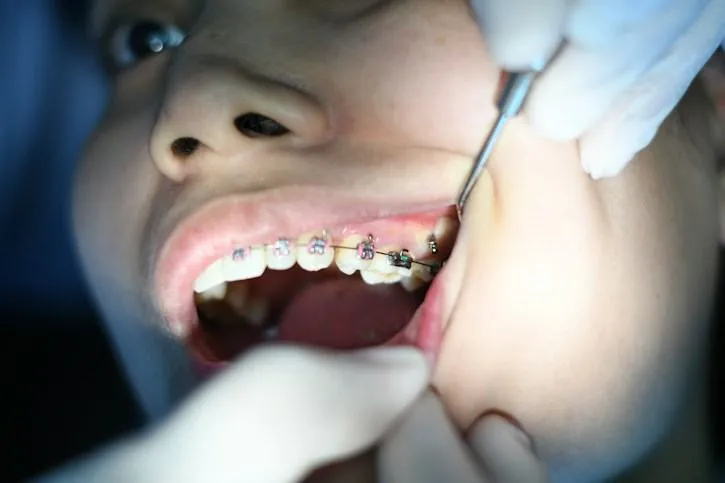
Removable and fixed braces
Correct contact between the teeth spreads the chewing forces evenly, so that they are properly transferred to the gums and bone. Well-aligned teeth are also easier to keep clean. Misaligned teeth often collect plaque, which threatens the health of the teeth and the gums. Braces are the devices we use to carry out orthodontic treatment.
How we carry out orthodontic treatment
We treat every patient individually. After a thorough clinical examination, a review of the X-rays and a detailed analysis of intraoral photographs, we propose a treatment plan to each patient. Thanks to our interdisciplinary work with Dario Repić, DDM, PhD, specialist in endodontics and restorative dental medicine, we can give every patient complete dental care during and after orthodontic treatment.
Besides detailed information about the health of their mouth, every patient receives all the written instructions they need on how their orthodontic appliance (braces) works and how to look after it, along with a suitable oral hygiene kit.
The orthodontic examination and treatment plan
The first orthodontic examination consists of a clinical examination of the mouth, teeth, bite and soft tissues, and an analysis of a panoramic X-ray (orthopantomogram). If you do not have one, you can have it taken at our clinic, where we use a state-of-the-art digital X-ray unit with a minimal radiation dose. For diagnosis we also take intraoral photographs with a specially adapted dental camera.
After the initial diagnosis we will propose a treatment plan, which we agree with the patient, or with the parents and the child.
Next, impressions are taken to make study models, so that we have a record of the bite before orthodontic treatment, that is, before the braces are fitted. The whole process is completely transparent, and we make sure you know at every stage what making and maintaining the orthodontic appliance (braces) will cost.
Frequently asked questions
What does an orthodontist do?
An orthodontist is a specialist who diagnoses and treats irregularities in the alignment of the teeth or the position of the jaws. They also work to prevent such irregularities from developing, using various orthodontic brackets and appliances.
Why do I need orthodontic treatment?
There are two main reasons for orthodontic treatment: function and appearance. Functionally, it improves how the teeth and jaws work together and makes oral hygiene easier. Aesthetically, a beautiful, attractive smile makes the face more expressive and striking, adds greatly to your self-confidence and helps you make a better first impression.
When is the right time to start orthodontic treatment?
There is no age limit for orthodontic treatment. Of course, the earlier an orthodontic anomaly is spotted and treated, the easier the treatment. The American Association of Orthodontists recommends a first orthodontic examination at the age of 7.
How can I recognise an orthodontic anomaly?
If you notice crowding or gaps between the teeth, an incorrect bite, a protruding upper or lower jaw, or teeth that do not meet properly when the mouth closes, we advise an examination by an orthodontic specialist. In children, habits such as thumb-sucking can also lead to an orthodontic anomaly.
Will fitting braces hurt?
Fitting braces is painless. Some patients feel slight pain or pressure for a few days after fixed braces are fitted, and minor pain can also appear after check-ups. A painkiller is recommended to ease the discomfort.
How long does orthodontic treatment take?
The length of treatment differs for every patient. The active phase (wearing braces) generally lasts 6 to 30 months. After treatment, a retainer has to be worn for several months to a year, depending on the original anomaly.
How often do I need to see the orthodontist?
Depending on the type of treatment, check-ups take place every 4 to 10 weeks.
Will I need teeth taken out?
If the teeth are severely crowded, or a tooth is impacted (has not erupted and is hidden in the bone), extraction is a possible treatment option.
Can I play a musical instrument or do sport?
Yes. Orthodontic treatment does not rule out these activities. If you do sport, we recommend wearing a mouthguard to prevent injuries to the mouth and damage to the braces.
Will I still need to see my dentist?
Of course. Check-ups with your dentist are extremely important. Braces make teeth harder to clean, so plaque builds up more easily, and with it tooth decay. Your dentist will prevent decay with regular cleaning and check-ups.
Will I wear a retainer once the braces come off?
Almost always, YES. After orthodontic treatment, a retainer has to be worn for several months to a year, depending on the original anomaly. Otherwise the teeth can return to their original position fairly quickly, and all the effort you and your orthodontist have put in will be wasted. How long the retainer is worn depends on the original anomaly.
How much does it all cost?
At your first examination you will receive a quote for the orthodontic treatment. The price includes the initial tartar removal and polishing, the active treatment phases from start to finish, fitting the fixed braces, check-ups, removing the braces and the first set of retainers. The first examination requires an X-ray of the whole jaw (orthopantomogram); we take it at our clinic and it is included in the price of treatment.
We use metal or aesthetic brackets, as the patient prefers. Aesthetic brackets make the fixed braces more discreet. We use products from the renowned orthodontic manufacturer American Orthodontics, and we will show you what the different brackets look like and how they differ at your examination.
Contact us
Book your appointment.
The first examination is free.
Fill in the form or give us a call — we will get back to you within our working hours.