
Implantology
Dental implants are a routine procedure that replaces lost teeth without any work on the neighbouring teeth.
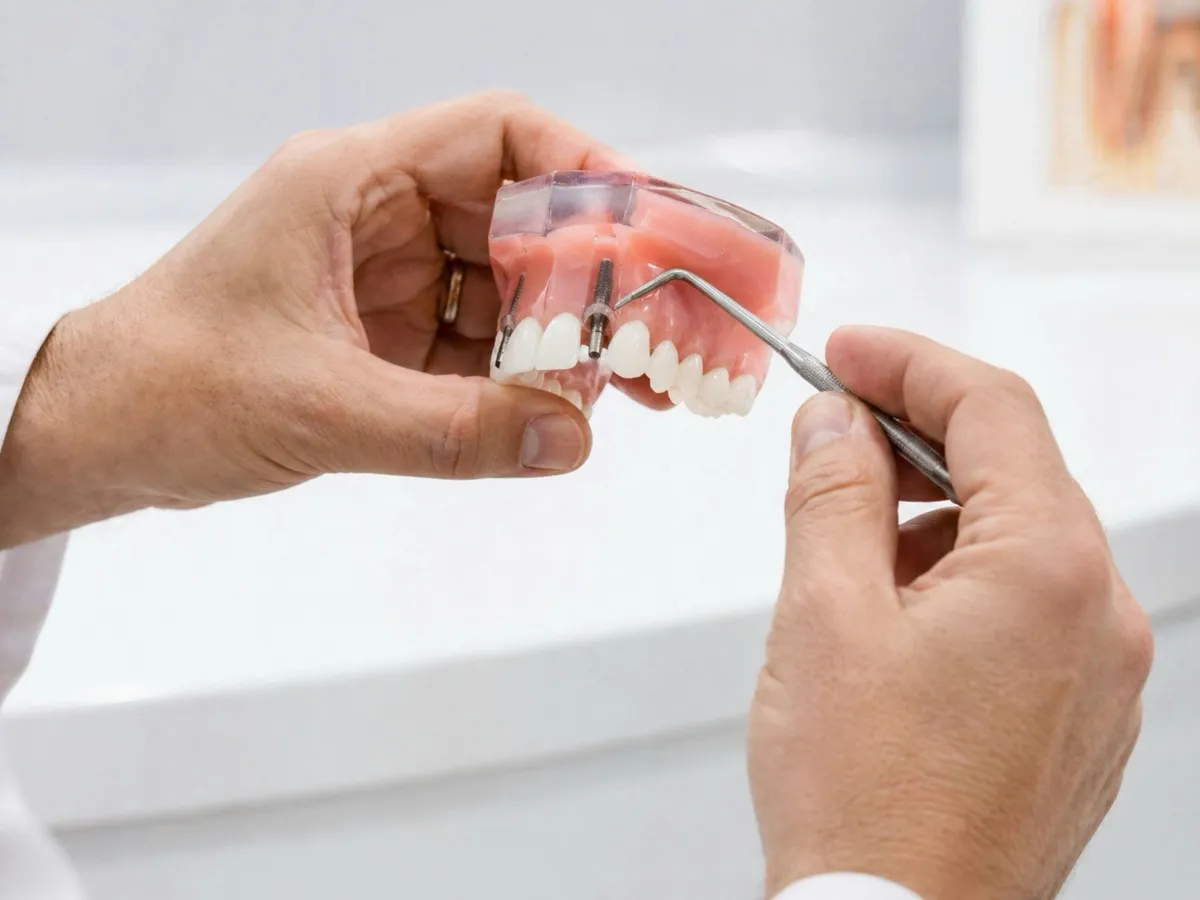
What are dental implants
With dental implants we replace one or more lost teeth in the upper or lower jaw. The implants replace the tooth root and, over 3 to 6 months, go through osseointegration (anchoring in the bone). During this time the patient is not left without teeth but wears a temporary replacement that provides appearance and function until the final prosthetic work is made. The final work can be a single crown on an implant, a bridge on implants or a denture on implants. An implant in the bone also helps preserve the amount of bone, that is, the alveolar ridge: it stimulates the bone much as a natural tooth does, so the bone does not shrink, which otherwise follows the loss of a tooth.
- Permanent solution
- Full return of tooth function
- Natural and beautiful-looking teeth
- Improved appearance of the whole face
- Prevention of bone loss
- Normal maintenance
When we recommend implants
When a single tooth is lost and the neighbouring teeth are healthy, we recommend an implant so that the healthy neighbouring teeth do not have to be ground down. A crown is then placed on the implant.
People who wear full dentures often struggle with dentures that do not hold well, which can be solved with a denture on implants. Four implants are usually enough to hold an upper overdenture in a completely toothless jaw, and two are usually enough for a lower one. Implant-retained dentures leave patients more satisfied than conventional dentures: they look better, are more stable, make chewing easier, limit function less, and make cleaning and speaking easier.
Implants can be loaded immediately (straight after placement) or conventionally (after the osseointegration period). Studies have shown that conventionally loaded implants have a slightly better survival rate in the mouth. The implants we use every day are made of high-quality, durable, biocompatible titanium, and placing an implant is completely painless under local anaesthesia. An implant needs enough bone of good quality, which we check with a panoramic X-ray and a CT scan before planning treatment. Where bone is lacking, bone augmentation and a sinus floor lift (sinus lift) are available.
What is bone augmentation?
After a tooth is lost, the bone shrinks because chewing no longer loads it through the tooth root. The bone volume decreases and there is not enough room for an implant. The bone shrinks faster if the extracted teeth had inflammation around their roots, as the infection has already destroyed some of the bone. Every implant needs enough bone around it to support and stabilise it, to stop the gum from receding around the implant and to avoid later aesthetic problems, such as the implant showing through the gum.
Bone augmentation is a surgical procedure that replaces lost bone. The missing volume can be rebuilt with manufactured bone of synthetic or animal origin, or with the patient's own (autologous) bone, taken from inside the mouth (the lower jaw) or from elsewhere in the body (for example the hip), ground and placed where bone is missing. The patient's own bone is the gold standard in bone augmentation, as it has the best potential to integrate and build volume. In that case enough bone has to be taken surgically to fill the defect. Small and medium-sized defects are mostly filled with manufactured bone of synthetic or animal origin. The oral surgery specialist decides on the method.
Healing of the bone and soft tissue after augmentation can be improved by adding the patient's own growth factors with the PRF method (platelet-rich fibrin), or by placing a biomembrane to stabilise the clot and the bone graft. In the PRF method, platelet-rich fibrin is separated from the patient's blood and applied to the surgical area. The platelets then release growth factors that stimulate new blood vessels and new bone. The method is harmless, as only the patient's own filtered blood is used to speed up healing. The placed materials are gradually absorbed, the bone remodels and new, firm bone forms. Bone augmentation is done under local anaesthesia and is completely painless. After the procedure the bone needs to heal (about eight months) before the implant can be placed.
What is a sinus lift?
When bone is lacking in the back of the upper jaw, raising the floor of the maxillary sinus (sinus lift) is indicated. In this oral surgery procedure the sinus floor is raised and bone is built up at the same time, so that there is enough bed for the implants. A sinus lift is done under local anaesthesia and is completely painless.
Depending on the size of the procedure, there is a small and a large sinus lift. If only about 2 mm of bone is missing for the implant, a small sinus lift is done, in which the implants are placed at the same time as the sinus floor is raised and the bone is built up. The procedure uses the osteotome technique, named after the instrument used to lift the membrane of the maxillary sinus. After a small sinus lift, the implant needs to fuse with the bone (about six months) before it can carry prosthetic work (a crown or bridge).
A large sinus lift is done when more bone volume is missing, through a so-called lateral approach. Sometimes the implant can be placed at the same time here too, but if a lot of bone is missing, a sinus lift with delayed implant placement is recommended. Then 6 to 8 months must pass between the sinus lift and the implant, otherwise there is a risk of complications and failure. The oral surgery specialist decides which procedure you need, based on their experience and your findings.
What complications can a sinus lift have?
A sinus lift has a high success rate and complications are uncommon, but possible. They can occur during the sinus lift or afterwards. While the sinus floor is being raised, the membrane of the maxillary sinus can tear, as its thickness varies from patient to patient. If it tears, the oral surgeon repairs the defect with various techniques and prevents later complications, such as sinus inflammation caused by bone graft material entering the sinus.
Mild swelling is possible after a sinus lift and goes away within a few days. Sinus inflammation is also possible for various reasons, for example an infection spreading from the mouth, the implant or bone material pushing through the membrane, or the procedure being done on a diseased sinus. A sinus lift requires healthy sinuses, so if the patient already has a sinus condition, they need to see an ear, nose and throat specialist before the procedure.
All-on-4
"All-on-4", or "all on four (implants)", is a form of implant-supported rehabilitation of a completely toothless lower or upper jaw. The method is not new; it has been well known and clinically successful for years. Over time after teeth are extracted, the jaw loses bone. If enough bone remains, a larger number of implants is recommended, as the prosthetic work then has more supports, but in some patients there is too little bone, or bone of poorer quality, for more than a few implants to carry the work. If the patient is a suitable candidate for All-on-4, only four implants are placed in the toothless jaw (two straight and two angled ones, which the oral surgeon takes care of when placing them), and they carry a fixed prosthetic bridge.
After the implants are placed, the patient receives a temporary fixed bridge the same day or within a few days at most, and the permanent fixed bridge three months later. This keeps the time without teeth to a minimum, which makes patients more satisfied. It is possible thanks to immediate loading: the implants are loaded as soon as they are placed in the bone, without waiting for osseointegration. All-on-4 has many advantages: it avoids sinus lift and bone augmentation in the upper jaw, which shortens recovery and lowers the cost; patients who have been toothless for a long time and have little bone left can still get a fixed bridge; and only four implants are placed, which hold the work so firmly that it feels like the patient's own teeth, with no fear of it falling out or moving, as with a full denture. The work is also screwed in place, so the dentist can easily remove, check and repair it if needed. Cleaning it is very easy, with a toothbrush and toothpaste plus a water flosser or dental floss around the implants. With good hygiene around them, the implants can last a lifetime, and only the prosthetic work is replaced when it wears out.
All-on-4 costs less than placing a larger number of implants in the jaw plus additional oral surgery, which makes a fixed bridge on implants affordable for more patients.
Instructions after implant placement
Wound care: avoid chewing on the operated side and rinsing your mouth for the first 24 hours. From the day after the operation, brush your teeth with a soft toothbrush, and if you have been prescribed an antiseptic (Curasept), rinse your mouth with it 2 to 3 times a day, starting the day after the operation. Avoid smoking so that the blood flow and the wound heal undisturbed.
Pain: take the first painkiller 30 minutes after the surgery, then as needed. Avoid Aspirin, Andol and other medicines containing acetylsalicylic acid, as they can prolong bleeding. If the pain does not ease, call us.
Bleeding: some bleeding is normal. Keep the gauze placed after the procedure pressed on the wound for at least 20 to 30 minutes. Avoid rinsing your mouth.
Swelling: swelling may appear a few hours after the procedure. Cool your cheek with cold compresses, alternating 20 minutes of cooling with 10 minutes' rest, and sleep with your head raised.
Food and activity: eat food that is as soft as possible and avoid hot food. Avoid physical activity and strong sun for 48 to 72 hours after the procedure.
Frequently asked questions
What is a dental implant?
A dental implant is a titanium screw shaped like a tooth root. It is placed surgically in the bone of the upper or lower jaw, following a treatment plan made beforehand. Two to six months after the implant is placed, a prosthetic abutment is fitted to it, which carries crowns, bridges or dentures.
What does implant placement involve?
- The first clinical examination includes a thorough check and analysis of the current state of your teeth, as well as a detailed analysis of a panoramic X-ray of the jaws (orthopantomogram). When planning treatment we take into account the clinical findings in your mouth, your wishes and expectations, and your budget, and on that basis propose treatment options. To help you fully understand them, we explain the situation using intraoral photographs of your teeth and demonstration models. After the first examination and your choice of treatment, we present a detailed plan for treating your current condition. It includes extracting teeth that cannot be saved, removing tartar and polishing, and repairing your existing teeth. If needed, temporary replacements are made the same day so that you can chew and look normal throughout treatment. If the clinical situation calls for more detailed diagnostics, we recommend a precise three-dimensional scan (CT) of the part of the jaw where the implants will go. The CT scan lets us determine the amount and quality of bone precisely and choose the best position for the implant. The clinical findings, the orthopantomogram and the CT scan allow us to make a detailed treatment plan, including the number and position of the implants and whether bone augmentation is needed.
- The next phase is placing the implants. You are prepared by rinsing your mouth with an antiseptic and receiving a local anaesthetic. This is followed by the surgical placement of the implant (incision, lifting the gum flap, exposing the bone ridge, preparing the implant bed, screwing in the implant, suturing, control X-ray). We emphasise that placing dental implants is not painful. Afterwards you receive detailed spoken and written instructions to ensure that the wound heals well and the implant integrates with the bone (osseointegration). The stitches are removed after seven days.
- Depending on the clinical situation, the next visit is two to six months after the implants are placed. The implants are uncovered and healing abutments are fitted, which help the gum heal and take shape.
- Once the abutments are in place, impressions are taken and sent to the dental laboratory, which makes your prosthetic replacements.
- The next phase is a try-in of the prosthetic work, which we review with you and the dental technician to correct any shortcomings.
- The final phase is fitting the finished prosthetic work!
What are the advantages of dental implants over other replacements?
If you are missing one or more teeth and have difficulty chewing or speaking, dental implants are the solution for you. They are also a suitable option if your dentures do not hold well or are uncomfortable.
Are dental implants safe?
Dental implants and prosthetic solutions on them have been a treatment of choice and an established part of clinical practice in well-equipped specialist clinics for more than 40 years. By using highly sophisticated, renowned implant systems, Dental Centar Repić gives you reliable, long-lasting results, both functionally and aesthetically.
How successful is implant placement?
Whether implants are indicated is decided individually, according to each patient's clinical condition and motivation. When the indication is right and oral hygiene is good, implant treatment is successful in 95% to 100% of cases.
Contact us
Book your appointment.
The first examination is free.
Fill in the form or give us a call — we will get back to you within our working hours.